Format Flash Drive In Mac Os
- Format Flash Drive Mac Os Extended Journaled In Windows
- Format Flash Drive-in Mac Os
- How To Format Usb Flash Drive To Fat32 In Macos
Mac OS Extended (Journaled) This format is considered as default file system format of the Mac OS X drives. It also supports OS X Lion, like Versions. This format will allow you to use your flash drive on Mac without any limitations. Attach the drive to your Mac. Launch Disk Utility (from Applications Utilities Disk Utility). Select the drive in the left-hand sidebar.
- Launch Disk Utility. Connect the USB flash drive to your Mac. If there are any files on the drive you.
- So, whether you wish to format the internal hard drive, external drive, or a USB flash drive, the procedure is the same for all. Here is the step by step guide you need to follow to format the hard disk on Mac.

Mac OS and Windows are both operating systems for your computer but they are very different in their components are sometimes functionalities. There are constraints on one side and vice versa but some of these constraints target both of the parties. One of these constraints is the format on which these operating systems perform their storage functions.
We are also no strangers to the fact that this is an era of portability and versatility of data. The problem at hand is that the portable storage media, such as a USB flash drive or an External hard drive can’t be used on both OS because they use different file systems. While the Mac OS can read the data present on the storage medium, it can’t write to it. There are file systems however that allow for communications for both Mac and Windows but you would have to format them first.
The procedure we will be telling you can be used for storage medium of all drive types, whether they are USB, external Hard Drives or Flash drives. Before you proceed, make sure you make a copy or a backup of the data present on the drives as it will be deleted when the format process takes place.
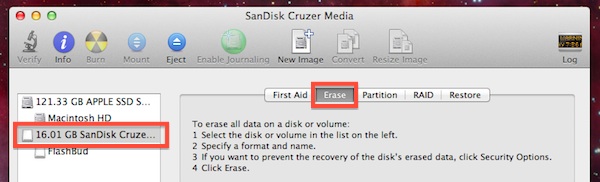
Steps for Hard Drive or USB Flash Drive Formatting
- The first step is to connect the hard drive or USB key to the Mac. If you have a newer version of MacBook or MacBook Pro then you would need to use a USB-C to USB-A adapters since the recent one only has USB-C ports.
- After that, open a Finder window and click on the drive you want to format and copy any sensitive data if there is any.
- When you are done with copying your data from the external drive to your Mac, go to Applications then click Utilities and then launch Disk Utility.
- Select the desired drive from the left side of the Disk Utility window and click on it
- Select Erase on the top and click Format. You will then be given a menu where various file systems will be present to offer you a choice.
- You can also name the drive here if you want if you want from the Name option but the name can be changed at any point
- Select the desired format and click Erase to confirm again on the window that pops up.
- If your desired media had any sensitive data on it you can opt for the Security tab to be on the safe side.
- While there, choose a security level using the slider. The further you move the slider to the right, the more securely the files will be deleted. It is worth mentioning that this increases the time it takes to format the drive.
Format Flash Drive Mac Os Extended Journaled In Windows
A factor to consider how fast the process will be completed is dependent on how big your media is. Smaller flash drives or HDD will be formatted much quicker compared to those with a bigger storage. Also if you want to read and write data on Windows and Mac OS then you should format the drive with the Fat32 file system. It allows for data manipulation on both operating systems, the only downside is that the files can no longer exceed 4GB.
Nowadays, when you buy a USB drive, you can use it right out of the box with your Mac. However, unless it’s been designed for use with a Mac, it won’t be formatted using macOS’ preferred file system (either Mac OS Extended or APFS, depending on which version of macOS you’re running).
That’s because most of the computers in the world run Windows, and Windows uses a different file system, usually one known as Fat32. Drives formatted as Fat32 can be read from and written to by macOS, but it’s not optimal and you’re more likely to run into problems than if you use macOS’ native format. So, if you’ve bought a USB drive that’s formatted as Fat32, or any other format other than Mac OS Extended (also known as HFS+) or APFS, here’s how to format a USB drive on Mac. It’s exactly the same procedure if you need to reformat a flash drive on a Mac.
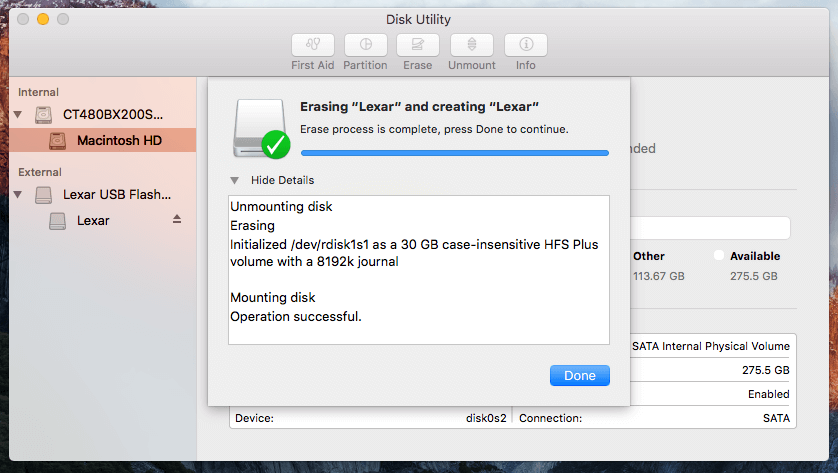
How to format a USB drive on a Mac
1. Plug the drive into a USB socket (if you have a recent MacBook or MacBook Pro that only has USB-C connectors, you’ll need a USB-C to USB-A adaptor).
2. Open a new Finder window and click on the drive. Make sure it has no files on it that you need. The process of reformatting it will wipe all the data from it.
3. Once you’ve copied any files you need from the USB drive to your Mac, go to Applications>Utilities and double-click on Disk Utility.
4. Click on the USB drive in the sidebar and then choose Erase from the toolbar at the top of the window.
5. In the window that drops down type a name for the formatted drive in the box next to Name.
6. Choose a format from the dropdown menu.
7. If you have previously stored sensitive data on the drive, click the Security tab.
8. Choose a security level using the slider. The further to the right you move the slider, the more ‘passes’ the erase tool will make and the more securely files will be deleted. However, it also increases the time it takes to format the drive quite considerably.

9. Click Ok then click Erase.
Tip: You don’t need to erase a whole drive to delete files securely. If you have confidential files or sensitive data you need to remove from your Mac completely, you should use CleanMyMac’s File Shredder. It’s specifically designed to securely delete sensitive data and will render it unrecoverable. You can download CleanMyMac X for free here.
Which format to choose?
If your Mac is running macOS High Sierra or later, you have two options for file formats: APFS and Mac OS Extended. Which should you choose? The key point is that disks formatted as APFS won’t be recognized by Macs running versions of macOS older than High Sierra. So if you think you might need to plug the USB drive into a Mac running an older version of macOS, format it as Mac OS Extended.
APFS is optimized for SSD (solid state drive) such as flash drives, so if you reformat a flash drive on a Mac, you should definitely choose APFS (unless you plan to use it with a pre-High Sierra Mac, of course). Even on hard drives, however, APFS is faster and more reliable than Mac OS Extended.
Finally, if you plan to use the USB drive as a destination for Time Machine backups, choose Mac OS Extended. Time Machine can’t currently back up to an APFS disk and if you select one for use with Time Machine, it will offer to reformat it as Mac OS Extended. You can, however, backup an APFS formatted disk to a Mac OS Extended Time Machine drive.
How to format a USB drive to FAT32 on a Mac
The main reason for formatting a USB drive as Fat32 on a Mac is that you want to be able to use the drive on a Windows PC, as well as a Mac — perhaps to transfer files between the two machines. You may also be preparing the drive for use as, say, a storage device for a media player or to record TV programmes on a TV with a USB port.
The fact that Fat32 can be read from and written to on both Mac and Windows makes it very versatile. However, there is a significant limitation — individual files have a maximum size of 4GB. So, if you’re using the USB drive to store large video files, you may run into trouble. There is a solution, however, exFAT. Unlike FAT32, exFAT doesn’t have a maximum file limit. Better still, it can be read from and written to on any Mac running Mac OS X Snow Leopard or later and on Windows.
To format a USB drive in FAT32 or exFAT:
1. Plug the USB drive into your Mac.
2. Go to Applications>Utilities and launch Disk Utility.
3. Click on the USB drive in the sidebar in Disk Utility.
4. Click Erase in the Disk Utility toolbar.
5. Type in a name for the formatted disk.
6. Click on the Format menu and choose either MS-DOS (FAT32) or ExFAT.
7. Click Erase.
Your USB drive will now be erased and re-formatted as either FAT32 or ExFAT, depending on the format you chose in step 6.
How to manage your drives easily
If you look for a quick and easy way to manage your drives, try using CleanMyDrive 2. With its help, you can drag-and-drop files directly to any drive, clean hidden junk from external drives, and check disk stats. It works for all drives, including USB drives, SSD, SD cards, external hard drives. All the drives will be at hand in the menu bar, so you can get to see types of drives you have and manage them easily. CleanMyDrive is absolutely free to use, so download it on the Mac App Store and enjoy!

Format Flash Drive-in Mac Os
It’s very easy to format a USB drive on a Mac using Disk Utility. There are a couple of things you should keep in mind, however. The first is that when you format and disk, you will erase all the data currently on it. So if you need that data, make sure you copy it onto another disk before you start. Secondly, there are several formats to choose from, each with advantages and disadvantage. Use the guide above to help you decide which is right for you.